

Hello! In support of the mini-retrospective of my early 16mm features premiering at Sujewa Ekanayake’s 3IAtlas Film Festival in Brooklyn, NY April 17-30 *(screening MORGAN’S CAKE (1988), BLUES FOR THE AVATAR (1995), PROSPECTS (2010), and my 27th feature BREAD MACHINE (2026), I’m re-running my filmography of low-no-budget indie features, first to last, to view for FREE here at Substack. Please enjoy this podcast about EMERALD CITIES, and viewing the full feature, here. My youtube channel is here.
————
(Here’s a little glimpse at the life of an indie flmmaker—How I strugled to get a scene shot during the ride home from the Death Valley shoot (Christmas,1979) of my 3rd feature, EMERALD CITIES).
Overcoming Resistance to Shooting at a Motel
Rising early on DAY-4, the morning of our drive home, I suddenly imagined a shot of actors Ted Falconi (guitarist, FLIPPER band) and Carolyn Zaremba (Z) exiting “their motel room,” including a long walk across the parking lot to his car, and started planning it. I was intent upon grabbing every morsel of scene- making shots before hitting the highway again. Suddenly I was fixated on getting that coverage. It seemed crucial to me––seeing Ted and Z walking together––as it would pick up the story again while giving the two characters more screen-time presence. So, as a precaution, I approached the desk clerk to get permission for the shots. I don’t always ask, since there is always a possibility of being turned down, but with so little filmstock I thought I’d better make sure I wasn’t going to be stopped in the middle. Anyway, I decided to take the risk of letting him know my intentions. I somehow doubted that there would be a problem (thinking positive here!), but I was completely mistaken. He immediately turned me down, with an emphatic “No.”
Umm...what?
He elaborated. “I can’t allow any shooting in the motel area.” I was stunned. I looked deep into the clerk’s face––dark skin, so maybe he was Middle Eastern, Iranian or Saudi, probably from one of those places, though he could have been Native American.
Wherever he was from, he spoke perfect English. But none of this mattered. All I knew was, I HAD TO GET MY SHOTS. In my mind, the film couldn’t afford to lose the material.
Co-cameraman Bill Kimberlin was standing with me in the office, and indicated I should follow him outside. Out front, talking together on the sidewalk with the stream of cars zipping down the highway in the distance while additional cast and crew stood around there in limbo, he reminded me about using a cash incentive, like I’d done offering $50 to a man named ‘Charlie’ to get a “Yes” when we shot at his house in Death Valley the previous half-week. So back I went, into the office, and followed Bill’s advice. But even with money offered, the clerk repeated No again, which was incredibly disturbing to say the least.
I continued to press my argument (“I spent money on four rooms,” and “It won’t take very long,” etc.). And I begged––I really need the shots!! But he wasn’t swayed. I walked back outside for a second time, to gather my thoughts (sanity!).
Bill was out of suggestions, as confused as I was at hitting the wall. I have no idea how all this was being viewed by my production group, but I wasn’t anywhere near ready to quit. In my mind there had to be some words that would unlock that stubborn guy. But I kept getting No.
After several more tries (how many, I lost track), I somehow stumbled onto the magical word combination. (Can you guess what I ultimately said?) Presenting my case again across the counter, I finally got it right.
“Working on this movie is, for me, just like working on your car is...maybe...for you. There is no money I’m making here. This is my hobby, my joy. I’m doing it out of love...as an artist. That’s all.”
And somewhere in the midst of those pleading words he softened, came around, finally agreeing to let me complete my task. I jumped on it immediately, before he could change his mind.
Quickly setting my camera up next to Ted’s distant car, I tested my long zoom to the motel door where he and Z would emerge, signaled the actors to exit on a door-tap cue, and got a close-up framing before calling “ACTION.”
After nailing their long (and windy) walk to the car (begun with a hefty zoom-out), I filmed a close-up of the couple seen through the car window––Z reliving Ed’s “3-song music calculator debacle” and her worry about his survival as a lonely drunk, with Ted caught up in performing some basic Zen breathing techniques to survive his car-mate’s distressful babble about deserting her old dad. (See scene/movie here)
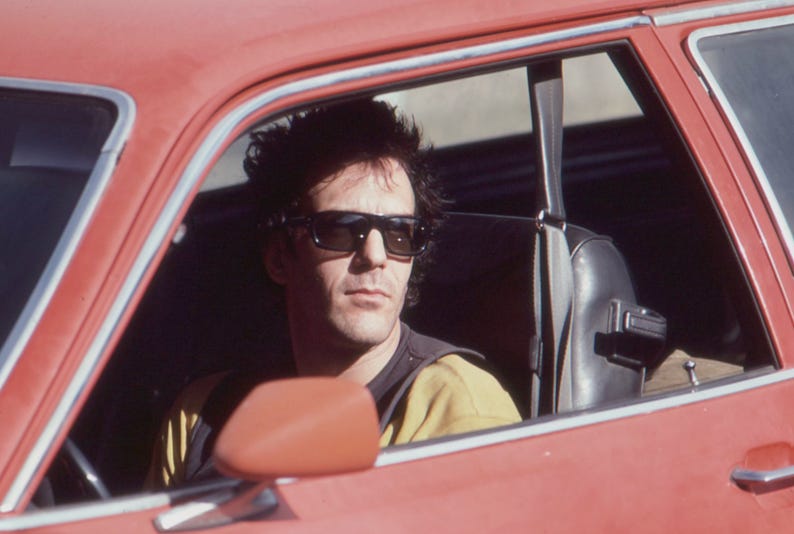
Band FLIPPER’S Ted Falconi. Photo by Julie Schachter.
Repositioning the camera for a final time, I shot Ted’s Pinto backing up out of its parking space, coming within millimeters of the camera and me. Ted hit the brakes just where my pre-set focus could read his bumper sticker, They Shoot Students, Don’t They (and I wouldn’t get run over!) then drove the car out of frame. And that was it. Two days of shooting were double wrapped. We arrived back home in Oakland (DAY-4), late that night.
————-
(Read more about the full EMERALD CITIES production experience in my book, NEW DARK AGES—NOW A PUNK MOVIE EMERALD CITIES GOT ITS IMPROV. Plus more info on the ‘making of,’ and my first films, by clicking here for article, “The Old New Dark Ages,” by Keith Phipps).
SEE MOVIE here:
————-


